An Exclusive Interview with Hon. Nabeela Farida Tunis, Minister of Tourism and Cultural Affairs, Republic of Sierra Leone
By Abdulai M. Braima,
Sierra Leone is working hard to redefine its place on the global tourism map, moving beyond conventional destination marketing towards a more inclusive, culturally driven and economically transformative tourism industry.
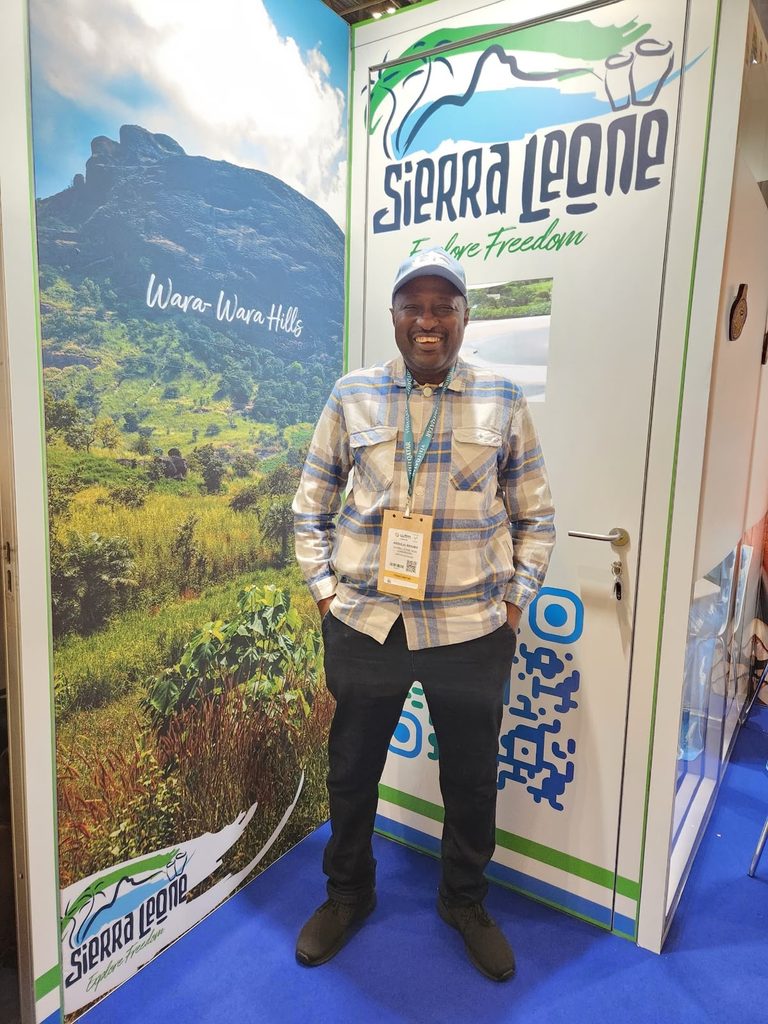
That ambition was evident at the just-concluded World Travel Market (WTM) London 2026, held from 3 to 5 November, where the Minister of Tourism and Cultural Affairs, Hon. Nabeela Farida Tunis, led Sierra Leone’s delegation in engagements with international tourism operators, investors, media organisations and development partners.
Against the backdrop of discussions on tourism resilience, sustainability and international cooperation, Sierra Leone presented an expanding portfolio of attractions and initiatives, from its pristine coastline and historical heritage to ecotourism, creative industries, gastronomy and community-based tourism.
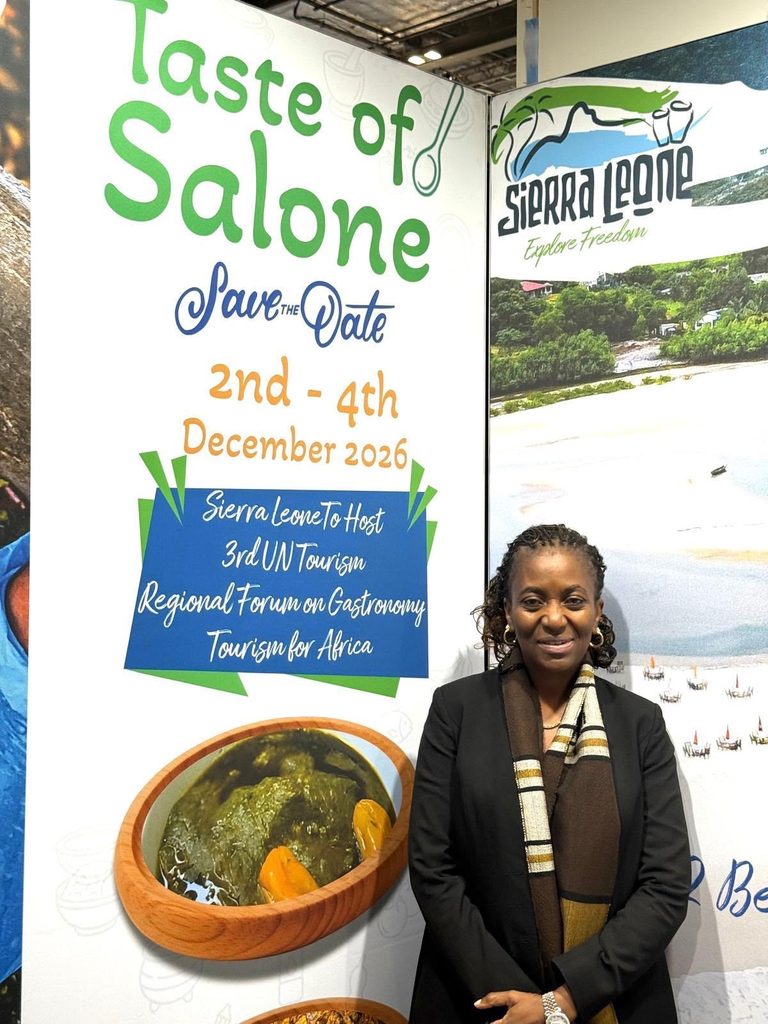
The country is also preparing to host two major international cultural and tourism events: the One Nation Reggae Festival, from 25 to 30 November 2026, and the 3rd UN Tourism Regional Forum on Gastronomy Tourism for Africa, from 2 to 4 December 2026.
On the sidelines of WTM London, Abdulai M. Braima, Sierra Leone’s Information Attaché at the High Commission in the United Kingdom, sat down with Minister Tunis for an extensive interview covering the country’s evolving tourism strategy, its international image, the opportunities emerging across the sector, the challenges of accessibility and her ambitions for the years ahead.
In this wide-ranging conversation, the Minister makes a compelling case for tourism as an instrument of national transformation, arguing that its benefits must extend beyond hotels and tourist attractions to farmers, fishermen, artists, entrepreneurs, young people and communities throughout Sierra Leone.
Please read below the full exchange from the interview with Minister Nabeela Farida Tunis……
AMB: Good day, Honorable Minister, and welcome to London. Naturally, I would like to begin with your participation in this year’s World Travel Market.
Sierra Leone has maintained a strong presence at this important international tourism event. Against that backdrop, and reflecting on the country’s tourism journey over the past few years, how would you assess the progress made, and what is fundamentally different about the direction in which the industry is moving?
MINISTER TUNIS:We have made significant progress, particularly in changing how we approach tourism and how we want the world to perceive Sierra Leone.
Our approach has become increasingly people-centered and participatory. We recognize that tourism cannot be developed successfully if it is regarded as the responsibility of the Ministry alone. It requires the involvement of the private sector, communities, cultural practitioners, young people and ordinary citizens.
AMB: What practical steps has the Ministry been taking to translate this vision into action?
MINISTER TUNIS: Beyond showcasing Sierra Leone on key international platforms such as *World Travel Market*, we have been working to strengthen and expand our national tourism ecosystem.
We have been adapting policies and programmes to encourage greater participation and create opportunities across different sectors of the economy. Another important development has been our emphasis on understanding the industry through data and feedback. Since 2023, we have placed increasing importance on collecting tourism statistics, understanding visitor experiences and using that information to inform our interventions.
Our Tourism for All approach is intended to ensure that tourism is not seen as an exclusive activity reserved for a particular category of people. We want Sierra Leoneans to understand that there is a place for everyone within the tourism industry. That is why we continue to emphasize the message: “Tourism business nar all man business.”
It is about creating an environment in which everyone can participate, contribute and benefit.
AMB: For many years, Sierra Leone struggled with an international image rigidly defined by its civil war and other national challenges. From your engagements with international tourism stakeholders, do you believe that perception is changing?
MINISTER TUNIS: Absolutely. I believe there has been a significant shift, although changing perceptions is always a continuing process.
Yes, there was a time when Sierra Leone was predominantly associated with the civil war and the difficulties the country had experienced. Those historical perceptions adversely affected how people viewed us as a destination.
Today, however, we are increasingly seeing interest in Sierra Leone for very different reasons. People are beginning to recognize and embrace our beautiful beaches, our unique natural environment, our biodiversity, our cultural diversity, our historical attractions and the warmth of our people.
We are also attracting attention through our tourism programmes, cultural festivals, ecotourism initiatives and international engagements. What is important is that we continue to tell our own story and encourage others to experience the country firsthand. We cannot allow the difficulties of our past to remain the defining image of our future.
Sierra Leone has so much to offer, and the more people visit and experience the country, the more they become part of the effort to change that narrative.
AMB: One of the major initiatives generating considerable interest is the One Nation Reggae Festival, scheduled for later this month. What is the vision behind the festival, and why is reggae such an important vehicle for Sierra Leone’s cultural and tourism ambitions?
MINISTER TUNIS: The One Nation Reggae Festival is much more than a musical event. It is about culture, identity, history, freedom, creativity and reconnecting people through shared experiences.
Reggae has a unique history and a powerful message of unity, resilience and liberation. These are themes that resonate strongly with Sierra Leone’s own historical experience.
When we look at our historical connections with the Caribbean, particularly Jamaica, we recognise that there are deep cultural and historical relationships that can be explored and strengthened through music, heritage and tourism.
We also have significant historical sites, including Bunce and Tasso Islands, which form part of the wider story of the transatlantic slave trade and the connections between Africa and the diaspora.
Through the festival, we want to create opportunities for people to understand these historical relationships while celebrating contemporary African and Caribbean creativity.
The inaugural festival provided an important foundation, particularly in creating opportunities for cultural exchange, artistic exploration and creative industry development. This year’s edition is designed to build on those achievements, demonstrate the progress already made and expand the opportunities available to Sierra Leonean artists, entrepreneurs and communities.
We want people to come to Sierra Leone not simply to attend concerts, but to experience the country, engage with its people, understand its history and participate in its cultural life.
AMB: What should visitors and Sierra Leoneans expect from this year’s six-day festival? What makes the 2026 edition particularly distinctive?
MINISTER TUNIS: We are developing a programme that brings together entertainment, education, cultural expression, heritage and entrepreneurship.
There will be musical performances featuring Sierra Leonean and international artists, alongside opportunities for collaboration and cultural exchange. But we are also looking beyond the stage.
One important component is the Sierra Leone Creative Expo, which will not simply be about showcasing talent, products and services. It will also provide an opportunity to demonstrate what we have achieved since the inaugural festival and highlight some of the tangible outcomes of our efforts to develop the creative industry.
One example is the Troupe Beat initiative, which blends traditional Sierra Leonean musical instruments and rhythms with reggae beats to create a distinctive fusion of sounds. This is particularly significant because it manifests how we can preserve our indigenous musical heritage while encouraging innovation, creative collaboration and new forms of cultural expression.
For us, this is what the festival should achieve: not simply bringing artists together for performances, but creating opportunities for their talents to develop, their work to gain recognition and our cultural heritage to find new expression.
The six-day programme has been designed to reflect these ambitions. We will begin on 25 November with the Liberation Carnival, which will celebrate freedom, unity and cultural expression. The Creative Expo will follow on 26 November, while the Freedom Tour on 27 November will take participants through important historical and cultural landmarks, helping them appreciate our heritage and the connections between Sierra Leone and the African diaspora. On 28 November, we will have the Fusion Concert, which will be the only event during the festival where audiences will have the opportunity to see our international artists perform live. They will share the platform with Sierra Leonean musicians and cultural performers, bringing together reggae, contemporary African music and traditional rhythms in a celebration of our cultural diversity.
The idea is not simply to stage an international concert, but to create a space where different musical traditions can interact, where our local artists can gain greater exposure and where the richness of Sierra Leone’s cultural identity can be celebrated alongside international creativity.
On 29 November, we will have Beach Freestyle, offering another dimension of the festival experience through music, entertainment and the celebration of our beautiful coastal environment.
Then, on 30 November, we will conclude with The Rebirth at Bunce Island. This will be particularly meaningful because Bunce Island represents an important chapter in our history, especially our ancestral connections with the African diaspora. Through this experience, we want participants to reflect on that history while embracing the themes of remembrance, resilience, reconnection and cultural renewal.
And, of course, we intend to bring out a few more surprises this year, which we believe will make the festival even more exciting and memorable.
What is particularly important is that the festival creates opportunities for different groups of people. Musicians, designers, craft producers, food vendors, transport operators, hospitality businesses and other entrepreneurs should all be able to benefit.
It is not just about bringing people together for entertainment. It is about creating an experience that connects culture with economic opportunity.
AMB: You have spoken about reconnecting Sierra Leone with the African diaspora, particularly communities in the Caribbean and the Americas. How do you see cultural tourism contributing to that process?
MINISTER TUNIS: Cultural tourism provides an important opportunity for people to reconnect with their history, heritage and identity.
Sierra Leone has a remarkable story, particularly when we consider its historical connections with the transatlantic slave trade, the settlement of freed Africans and the development of Freetown.
These connections extend to communities in the Caribbean, North America and elsewhere, including the Gullah Geechee communities. There is considerable potential to develop tourism experiences that allow people to explore these shared histories.
But heritage tourism should not be limited to visiting historical monuments. It should also involve interaction with communities, cultural exchanges, storytelling, music, food and other experiences that help people understand their connections.
We want members of the diaspora to see Sierra Leone as a place where they can reconnect, explore, build relationships and potentially identify opportunities for investment and collaboration.That is part of the broader vision of positioning Sierra Leone as a destination that offers meaningful experiences.
AMB: Barely days after the One Nation Reggae Festival, Sierra Leone will host the 3rd UN Tourism Regional Forum on Gastronomy Tourism for Africa. Why is this event particularly important, and what opportunities does it present for the country?
MINISTER TUNIS: Gastronomy is an extremely important component of tourism because food is one of the most direct ways through which people experience a country’s culture.
When people travel, they want to experience the food, understand how it is prepared, learn about the ingredients and discover the traditions associated with it.
Sierra Leone has a very rich culinary heritage, and we want to showcase that heritage to the world.
Hosting the UN Tourism Regional Forum on Gastronomy Tourism for Africa provides an opportunity to bring together international experts, policymakers, chefs, entrepreneurs and other stakeholders to discuss how gastronomy can contribute to tourism development.
But for us, it is not simply about hosting an international conference. We want to create stronger connections between tourism, agriculture, food production, hospitality and entrepreneurship.
AMB: How do you intend to achieve this?
MINISTER TUNIS: I will give you one key example. When we promote the farm-to-table concept, we are looking at the entire value chain.
The farmer who produces the vegetables, the fisherman who supplies the seafood, the transporter who brings the produce to market, the person who processes it and the chef who prepares the meal are all contributing to the tourism experience.
If we develop those connections properly, tourism can create economic opportunities for many more people.
We also want to preserve our traditional recipes and food preparation methods, while encouraging innovation and improving standards.
Our food is part of our identity, and it should become an important part of how we promote Sierra Leone internationally.
AMB: Women are particularly active in Sierra Leone’s agricultural, food-processing and hospitality sectors. How can the gastronomy initiative translate into meaningful economic opportunities for them and for young entrepreneurs?
MINISTER TUNIS: Women play an extremely important role throughout the food value chain, from production and processing to preparation, marketing and hospitality.
We therefore have to look at how we can strengthen their participation and create opportunities for them to expand their businesses.
One of the challenges is that many people have valuable skills and products but lack the exposure, market access or support needed to develop those activities into sustainable enterprises.
Through our gastronomy initiatives, we want to create platforms where these individuals can showcase what they do, learn from others and connect with potential customers and business partners.
This includes established restaurants, emerging chefs, traditional food producers and street-food vendors.
We should recognise excellence wherever it exists. Someone preparing outstanding traditional food in a community may have something just as valuable to contribute to our tourism experience as a major hospitality establishment.
Our responsibility is to create the environment in which these opportunities can be identified, developed and promoted.
AMB: One concern frequently raised is that major tourism and cultural events tend to be concentrated in Freetown. How is your Ministry ensuring that people in provincial communities such as Bo, Kenema, Makeni, Kono, Kabala and Kailahun are not left behind? Where do rural communities stand in this?
MINISTER TUNIS: That is a very important issue, and it is one of the reasons we have placed so much emphasis on inclusive tourism.
We do not want tourism development to be concentrated in Freetown.
Sierra Leone has extraordinary tourism assets throughout the country, and communities outside the capital must be able to participate in and benefit from the industry.
We have been engaging communities and promoting tourism activities in different parts of the country, including Bo, Kenema and Makeni.
Our approach is to encourage people to recognise the opportunities within their own communities.
Some communities have beautiful natural attractions. Others have historical sites, cultural traditions, agricultural activities or unique experiences that could be developed into tourism products.
We want to help communities understand these opportunities and encourage them to take ownership.
For example, when we speak of community-based tourism and initiatives such as Hello Sulima, we are looking beyond traditionally established tourist destinations to uncover previously unexplored locations and demonstrate how meaningful local participation, environmental conservation and enterprise development can work together to create sustainable livelihoods and lasting economic opportunities for communities.
Tourism must provide benefits to the people who live in and around these attractions.
If communities see the economic and social value of tourism, they are more likely to protect their environment, preserve their heritage and contribute to the sustainability of the industry.
AMB: Beyond community participation, how do you see tourism attracting investment and creating opportunities in areas that are not traditionally regarded as part of the tourism industry?
MINISTER TUNIS: Tourism is interconnected with many other sectors, and that is one of its greatest strengths.
When a visitor comes to Sierra Leone, that person is not simply interested in accommodation or sightseeing. They may become interested in agriculture, fisheries, mining, property development or other investment opportunities.
But what initially attracts them may be the beauty of the country, its people, its culture and the experience they have during their visit.Tourism can therefore serve as an entry point into other sectors of the economy.
We are also looking at opportunities for investment in tourism infrastructure, accommodation, hospitality services and the development of new destinations. There are areas where investment can help unlock the potential of attractions that have not yet been fully developed. However, we want such development to be environmentally friendly, sustainable and to involve the communities concerned.
Our aim is not simply to attract investment, but to ensure that investment creates jobs, strengthens local businesses and contributes to long-term economic development.
AMB: International accessibility remains a major consideration for tourists. Air connectivity, travel costs and the ease of reaching Sierra Leone can influence people’s decisions. How is the country addressing these challenges?
MINISTER TUNIS: Accessibility is very important, and we recognise that visitors consider several factors when deciding where to travel.
We are continuing to promote Sierra Leone as a destination while also highlighting the different routes through which people can reach the country.
One interesting development we have observed is the growing number of visitors coming through other West African countries, particularly Ghana, Liberia and Guinea. Some travelers may fly into one of these countries and then continue their journey to Sierra Leone. We are encouraging people to recognize the opportunities for regional travel because West Africa has so much to offer. Our roads have improved, and travelling through the region can itself become part of the tourism experience.
The landscape is beautiful, and visitors can experience different cultures and attractions along the way. We do not see neighboring countries simply as competitors. Each country has its own unique tourism offerings. What visitors experience in Guinea will be different from what they experience in Sierra Leone or Liberia. We should therefore encourage people to explore more than one destination.
When people visit Sierra Leone, we can encourage them to extend their journey to neighboring countries, just as travelers visiting those countries can be encouraged to include Sierra Leone. It is about promoting regional tourism and making the entire experience more attractive. When people visit Sierra Leone, we can encourage them to extend their journey to neighboring countries, just as travelers visiting those countries can be encouraged to include Sierra Leone.
It is about promoting regional tourism and making the entire experience more attractive.
AMB: Doesn’t that answer somewhat deflect from facing up to the cost of flying directly into Freetown?
MINISTER TUNIS: Absolutely not. We are working on all fronts at the same time. Not too long ago Sierra Leone inaugurated a brand new airport with comfortable facilities. The traffic in that area is encouraging. You should know about the growing developments in Lungi with the ultra modern Julius Maada Bio International Conference Centre and the upcoming modern hotels. We have a growing city in Lungi that is poised to stand out as its own
AMB: Looking ahead to the next few years, what is your biggest ambition for Sierra Leone’s tourism sector? What would you most like to see achieved?
MINISTER TUNIS: My biggest dream is to see a significant increase in tourist arrivals.
That is very important because increased arrivals create a market for the jobs and businesses we are developing within the tourism industry. When more visitors come, they spend money on accommodation, food, transport, entertainment and other services. That spending supports businesses, creates employment and contributes to the local economy.
But there is another important dimension. As I have explained, visitors may initially come because they are attracted by the country’s beauty, but once they are here, they may identify opportunities to invest in other sectors. Tourism can therefore become a gateway to wider investment and economic development.
I want to see more people visiting Sierra Leone, spending money in our communities and helping to create opportunities for our people. At the same time, we must continue to strengthen domestic tourism.
AMB: Apart from what you have mentioned earlier, can you you outline any other efforts to promote domestic tourism?
MINISTER TUNIS: Absolutely. Domestic tourism is one of the key areas receiving increasing attention. Since 2024, we have placed particular emphasis on encouraging Sierra Leoneans to travel within their own country, discover its rich cultural and natural heritage, and appreciate the remarkable attractions and experiences available right on their doorstep.
We want people to travel from Freetown to Bo, from Bo to Kenema, from Port Loko to Freetown, from Kailahun to Kabala and across other parts of the country, not just as routine journeys but to see and appreciate what we have as a nation. When people travel domestically, money circulates within the economy, supporting businesses and livelihoods in different communities. That is also part of building resilience.
We are additionally looking at how to involve younger generations in shaping the future of tourism. We have started encouraging intergenerational conversations in which young people can tell us what they want the tourism industry to look like in the years ahead.
Their perspectives are important because they are the future of the industry.
AMB: Undoubtedly, you have brought considerable energy and visibility to the tourism sector, and Sierra Leoneans are increasingly recognising the country’s potential. As we conclude, what message would you like to leave with Sierra Leoneans about their own responsibility in sustaining this transformation?
MINISTER TUNIS: I want Sierra Leoneans to see tourism as their bread and butter.
Tourism is so diverse and so interconnected with many other sectors that there is an opportunity for everyone to participate. You do not necessarily have to be highly educated, well connected or financially privileged to find a productive space within the tourism industry. There are opportunities for people with different skills, experiences and abilities.
What I really want is for Sierra Leoneans to embrace tourism and help us market the country.
I remember speaking at World Travel Market in 2023 about the importance of posting something positive about Sierra Leone. I still want us to continue along that path because what we post can generate considerable interest, even beyond what we may have contemplated.
We need to adopt practices that will enhance tourism. Let us care for our beaches. Let us look after our environment. Let us welcome visitors. Let us present ourselves and behave in ways that make visitors feel comfortable and appreciated. We are already known for our hospitality, but we must take that reputation a step further. We should ensure that anyone who comes to Sierra Leone to explore our country has an experience of a lifetime. If people have a wonderful experience, they will want to return, and they will encourage others to visit.
That is how we can all contribute to building a stronger tourism industry.
Tourism is everybody’s business, and we all have a role to play in its success.
EDITORIAL COMMENT: A NATIONAL INDUSTRY, A SHARED RESPONSIBILITY
In this interview, Minister Tunis’s vision places tourism at the intersection of culture, commerce, heritage, environmental stewardship and national identity.
Throughout the interview, one message emerges consistently: Sierra Leone’s tourism transformation cannot be measured solely by the number of international visitors it attracts. Its enduring value must also be reflected in the livelihoods it supports, the businesses it creates, the communities it empowers and the heritage it preserves.
With major international events approaching, expanding interest in the country’s cultural and natural attractions, and growing opportunities for collaboration across the region and beyond, Sierra Leone has an opportunity to turn renewed international attention into sustainable economic progress.
The challenge will be to ensure that this ambition translates into tangible improvements across the tourism value chain, from major investors and hospitality operators to small businesses, rural communities and ordinary citizens.
For Minister Tunis, the message is clear: *Sierra Leone’s tourism future is not simply about inviting the world to discover the country. It is also about encouraging Sierra Leoneans to rediscover their nation’s value, take ownership of its opportunities and participate in shaping its future*.
Interview conducted by Abdulai M. Braima on the sidelines of World Travel Market London 2026.